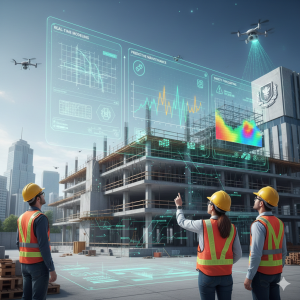
Focus: Real-Time Modeling for Predictive Maintenance and Safety Forecasting
Government construction projects are becoming increasingly complex, requiring advanced technology to manage costs, schedules, and safety. Digital twin technology is revolutionizing the way agencies and contractors approach these challenges by providing a real-time, virtual replica of physical assets for monitoring, analysis, and decision-making.
What is Digital Twin Technology in Construction?
A digital twin is a dynamic digital model of a physical asset or system, continuously updated using data from sensors, drones, IoT devices, and BIM (Building Information Modeling). In government construction projects, digital twins can represent:
-
Bridges and tunnels
-
Roadways and highways
-
Public buildings and utilities
-
Infrastructure critical to federal, state, or local projects
By integrating real-time data, digital twins allow project teams to simulate scenarios, monitor asset performance, and make predictive decisions, ensuring projects stay on schedule and within budget.
Applications of Digital Twin Technology in Government Construction Projects
1. Predictive Maintenance for Government Infrastructure
Predictive maintenance is a core benefit of digital twin technology. Sensors embedded in infrastructure — such as bridges, tunnels, or HVAC systems — feed data into the digital twin, allowing teams to anticipate failures before they happen.
Benefits:
-
Reduces unplanned downtime and emergency repairs
-
Extends the lifespan of government assets
-
Optimizes maintenance budgets by targeting critical areas
Example:
For a federal highway bridge, a digital twin monitors structural stress in support beams and predicts potential points of failure. Maintenance crews can intervene proactively, preventing costly damage and ensuring public safety.
2. Safety Forecasting in Construction Projects
Construction sites are inherently high-risk environments. Digital twins enable real-time safety forecasting by simulating environmental factors, load distribution, and operational conditions.
Benefits:
-
Minimizes workplace accidents and injuries
-
Supports emergency response and evacuation planning
-
Ensures compliance with safety standards like OSHA and EM 385-1-1 for USACE projects
Example:
During a government dam construction project, a digital twin can simulate stress on the structure under heavy machinery or flooding conditions, allowing teams to implement preventive safety measures.
3. Real-Time Project Monitoring and Quality Control
Digital twins integrate BIM models with live sensor data to monitor project progress virtually. This ensures better quality control, schedule management, and compliance.
Example:
For a federal hospital expansion, project managers can track construction milestones remotely, identify design deviations early, and reduce costly rework — ensuring the project meets specifications and deadlines.
4. Supporting Construction Sustainability Practices
Digital twin technology also enables construction sustainability practices, optimizing energy, materials, and operational efficiency in government infrastructure.
Example:
A government office building can use a digital twin to manage HVAC systems, lighting, and energy usage, reducing costs while lowering the building’s carbon footprint.
Why Digital Twins Are Essential in Government Construction Projects
Using digital twin technology provides government agencies and contractors with:
-
Predictive Maintenance: Anticipates failures and reduces emergency repairs
-
Enhanced Safety Forecasting: Prevents accidents and supports regulatory compliance
-
Efficient Project Monitoring: Improves scheduling, quality, and oversight
-
Data-Driven Decision Making: Optimizes budgeting, planning, and operations
-
Sustainable Construction Practices: Promotes energy efficiency and responsible resource use
Conclusion
Digital twin technology is a powerful tool transforming government construction projects. By offering real-time modeling, predictive maintenance, and safety forecasting, digital twins help teams deliver projects that are safe, efficient, and sustainable.
At Titan Consultants, we integrate advanced technologies like digital twins into our project management processes, ensuring government-funded construction projects achieve the highest standards of safety, compliance, and operational excellence.